Which Stainless Steel Grade Suits Which Facade? 445J2, 316L and 304 by Building Type
Contents12 sections
- 1. What Actually Decides the Grade?
- 2. How Do You Read the Environment Before the Grade?
- 3. Why Does a Welded Roof Want a Ferritic Grade Like 445J2?
- 4. What Does the Qingdao Airport Roof Prove?
- 5. Why Does a Super-High-Rise Default to 316L?
- 6. Where Is 304 Still the Right Answer?
- 7. What Actually Fails on a Stainless Facade?
- 8. Which Grade Belongs to Which Building Type?
- 9. What Changes in Fabrication When the Grade Changes?
- 10. How Do You Stop the Grade Being Substituted?
- 11. What Should Be Sent for a Grade Review?
- Frequently Asked Questions
Grade follows the building, not the catalogue. A welded roof wants a ferritic grade such as 445J2, whose movement stays close to carbon steel. A coastal tower wants 316L. An inland wall that salt never reaches still wants 304. Decide the exposure and the construction first.
1. What Actually Decides the Grade?
Three things decide the grade, and none of them is the price per tonne. How far the panel runs before it meets a movement joint, what the air carries in chloride and sulphur, and what the panel looks like after ten years of that air.
A roof that runs forty metres in one welded sheet is a movement problem. A six-hundred-metre tower is a wind-driven salt problem. A three-storey inland wall is a cost problem until de-icing salt reaches it.
That is why the same alloy family answers all three with different grades, and why a table of nickel and molybdenum content never settles a specification on its own. Stainless is bought for the surface; the grade is bought for the mechanism that will actually fail.
Read as a stainless steel grade by application, the question narrows: not which alloy is best, but which alloy survives the failure mode this building actually has.
This article takes the three grades we supply — 445J2, 316L and 304 — and puts each against the building type it belongs to. The projects named below are public references, not our projects. They are cited because they show what each grade does at a scale no sample can.
2. How Do You Read the Environment Before the Grade?
The useful unit is not distance from the sea but corrosivity at the surface. ISO 9223 sorts atmosphere into C1 to C5 and CX, and for a facade the question is not whether the structure survives but whether the appearance does: a brown stain along a rain line is read as failure long before any section loss.
| Class | Typical setting | Grade that fits | Grade to avoid |
|---|---|---|---|
| C1–C2 | Inland, low pollution, rain washes the face | 304 | — |
| C3 | Ordinary city, inland industry | 304; 316L if the budget allows | — |
| C4 | Industrial air plus moderate salt, near-coastal city | 316L, 445J2 | 304 |
| C5 | Coast, heavy salt, splash-adjacent | 316L, 445J2, 2205 at fixed points | 304 |
| CX | Sea edge, spray zone, permanent wetting | 2205, 904L; specialists involved | 304 or 316L without review |
Two traps sit outside that table. De-icing salt behaves like a coast in the middle of a continent: IMOA's guidance records salt spray carrying about 1.9 km, corrosivity within 100 m of a treated road matching a moderate to severe coastal site, and a Chicago case where attack appeared on the sixtieth floor. A project in Beijing or Xi'an cannot default to 304 because it is not by the sea.
The second trap is the surface, not the grade. A horizontal ledge that holds salt, a rough grain that holds water, a joint that cannot drain: each turns a correct grade into a stained one. The environment is read at the detail, not at the postcode.
3. Why Does a Welded Roof Want a Ferritic Grade Like 445J2?
A welded stainless roof is a membrane, not a set of tiles. Once the sheets are welded into a continuous surface, the roof expands as one piece, and every millimetre of that movement has to go somewhere. On an austenitic grade the movement is large enough that the design answer becomes a schedule of movement joints — the roof is cut into bays, each bay slides, and each joint is a place where water is eventually invited in.
A ferritic grade changes that arithmetic. 445J2 is an ultra-pure ferritic stainless with molybdenum and stabilising additions, and its thermal expansion sits close to carbon steel rather than close to the austenitic family. The consequence is structural: a run can be longer before a movement joint is needed, and a longer run is what makes a welded roof worth building.
The second consequence is the sheet. At 0.5 mm the panel has almost no stiffness of its own, so it survives by being welded to the structure and by not fighting it. A material that grows noticeably more than the steel beneath it turns every fixing into a fatigue point; a ferritic sheet that moves with the structure turns the same fixing into a restraint.
What 445J2 does not remove is fabrication discipline. Ferritic grades weld with thermal behaviour closer to carbon steel but demand more control of heat input, because grain growth and toughness in the heat-affected zone do not forgive a hot, slow pass. A ferritic roof is a specification decision and a qualified welding procedure at the same time.
Austenitic grades remain the better answer for complex double-curved panels, where ductility matters more than movement; that trade is worked through with the standing seam, folded and curved roof panels geometry.
4. What Does the Qingdao Airport Roof Prove?
Qingdao Jiaodong International Airport is the reference that settles the argument. Industry reports describe its terminal roof as the largest continuously welded stainless roof in the world, formed from sheet reported at 0.5 mm in grade B445J2, with a shallow transverse texture stiffening a 400 mm pan and robotic welding closing the surface into one membrane.
Read four facts together and the logic is visible. The sheet is thin because the roof is a stressed skin, not a deck. It is continuously welded because a joint every few metres would leak and would cost more than the welding. It is textured because a flat 0.5 mm pan would read as a wave under a low sun.
And it is ferritic because a skin at that scale cannot absorb austenitic expansion without the joint schedule that welding was meant to remove.
There is a corrosion argument too, and it is secondary: 445J2 carries molybdenum, which is what buys pitting resistance in marine air. But if pitting were the only criterion, 316L would have been the simpler answer, and it was not the answer chosen. The roof was decided by movement first and corrosion second — the correct order for a roof, and the wrong order for a curtain wall.
One caution for anyone copying the case: 0.5 mm is a roof figure inside a welded system with full support behind it. It is not a facade thickness, and it does not transfer to a rainscreen panel spanning between brackets.

5. Why Does a Super-High-Rise Default to 316L?
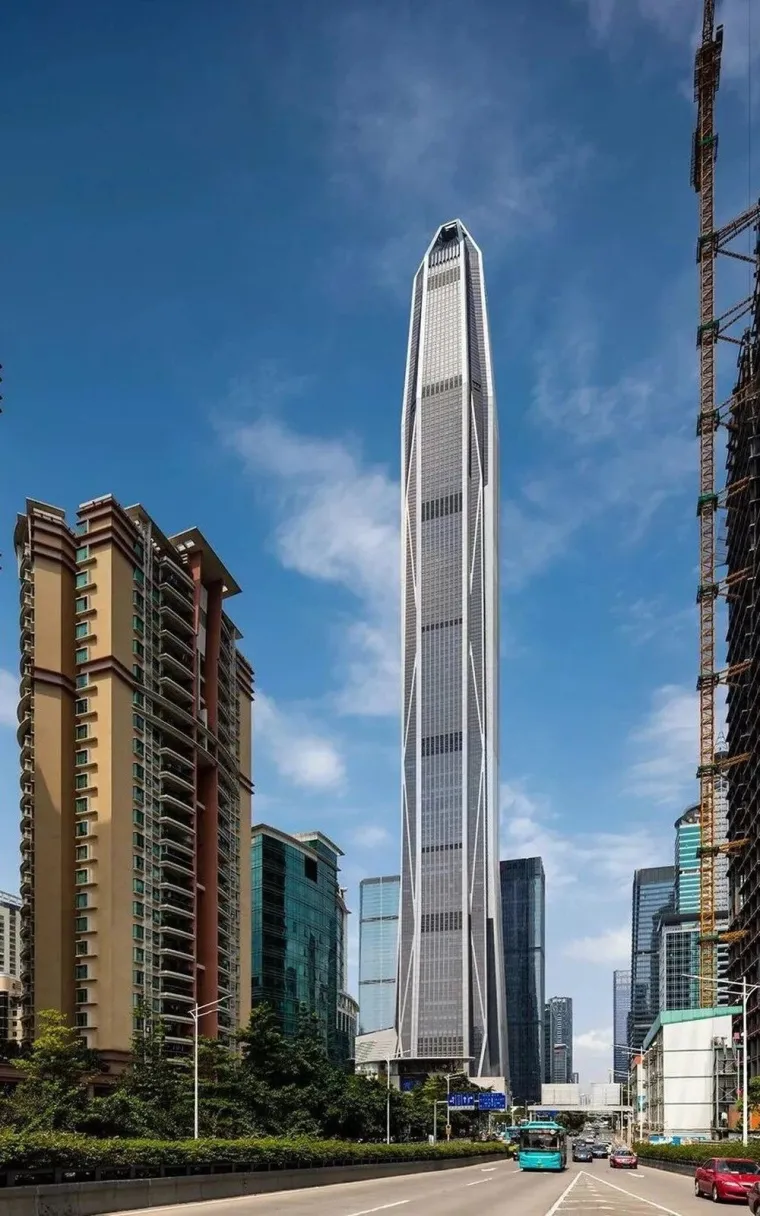
The Ping An Finance Centre in Shenzhen is the counter-case. Its stainless facade is put at roughly 1,700 t in published records, in grade 316L, on a tower of about 599 m in a coastal city; industry reporting places the clad area near 174,316 m². New York's 3 World Trade Center takes the same grade at 550 t, with a woven texture rather than a polish.
The reasoning mirrors the roof. At 600 m nothing is reachable: a panel that pits cannot be swapped from a cradle without closing the floor below it, and a facade that needs re-finishing is a permanent operating cost. So the grade is bought for corrosion resistance, and the movement problem is solved by the system instead — unitized panels, sliding brackets, and a joint designed to take the accumulation over one floor height.
316L also carries the fabrication qualities a tower needs: it forms and welds predictably, it takes the mechanical and PVD finishes the elevation depends on, and it arrives in the coil widths unitized lines are set up for. At that scale the grade decision is also a supply decision.
Where 316L stops being the answer is at the joint, not at the alloy. Specifying 316L and then reducing the bracket to a fixed cleat is how a correct grade produces an incorrect facade. The head-to-head of the two austenitic grades — pitting resistance, nickel and molybdenum, and where each stops — is set out in 304 vs 316L, and is not repeated here.
6. Where Is 304 Still the Right Answer?
Most buildings are neither an airport nor a 600 m tower, and for them 304 is not a compromise. The Gateway Arch in St. Louis has carried a 304 skin of 6.3 mm, 804 t and a No. 3 ground finish since 1965 in an inland city, and it still reads as the city's symbol. That is the strongest argument for 304: used where the air is mild and rain washes the face, it does not age into a maintenance item.
The test is whether chloride reaches the surface wet and stays there. Splash zone, prevailing wind, shelter from the building next door, and salt on a treated road below all change the answer more than the map does. A 304 facade twenty kilometres inland in a city with no marine fetch behaves differently from the same panel two kilometres from a surf line.
Reachability is the second test, and it is usually skipped. If a scratched panel can be re-grained from a mobile lift, the maintenance case for a higher grade weakens. If every repair needs a mast climber and a permit, the higher grade pays for itself the first time a tool is dropped.
Below 304 sits 201, which replaces part of the nickel with manganese. It forms and welds like the 300 series and takes the same finishes, which is why it appears on interior packages; what it does not carry is the corrosion margin, so outdoors it belongs only to sheltered, dry elements and only with the client's written acceptance.
Where 304 is used outdoors at scale, the finish does as much work as the grade: a directional brushed face that holds water behaves worse than a smoother or non-directional face in the same exposure. The pairing is worked through in choosing grade and finish for coastal and desert climates, which sorts elevations by exposure class rather than by building type.
7. What Actually Fails on a Stainless Facade?
Stainless does not fail the way steel fails. It holds its structure and loses its appearance, which is why the acceptance argument is about stains and streaks rather than section loss. Six modes cover most site reports, and each one has a cause the specification can address before the panels are made.
| Mode | On site | Cause | Prevention |
|---|---|---|---|
| Pitting | Pinpoint rust, often starting at a scratch or an inclusion | Chloride breaks the passive film locally | Higher molybdenum grade, lower roughness, no chloride traps |
| Tea staining | Brown streaks following the rain lines | Salt and dirt held on the surface, film locally depleted | Higher grade, no upward ledges, steeper slope, periodic washing |
| Galvanic attack | The aluminium or carbon steel part beside it corrodes first | Dissimilar metals in an electrolyte | Isolating washers, same-family fasteners, no small anode against a large cathode |
| Weld and HAZ attack | Knife-line rust along both sides of a seam | Sensitisation, mismatched filler, no post-weld cleaning | Low-carbon or stabilised grade, over-alloyed filler, pickling and passivation |
| Crevice attack | Rust under a lap, a gasket or a bolt head | Oxygen-starved gap, chloride concentrates | Seal the lap, drain the detail, avoid joints that hold water |
| Forming cracks | Micro-cracks on the outside of a bend, wrinkles on a curved panel | Low ductility reserve, work hardening | Larger bend radius, anneal, or change to a formed-instead-of-pressed route |
The counter-intuitive point is worth stating plainly: stainless depends on a passive film, and the film depends on oxygen, rain and a clean surface. Bury it under dirt, salt or oil, contaminate it with iron, or destroy it with a weld, and it will stain like anything else. Appearance is what fails first, and appearance is what the client is buying. IMOA's own guidance records that, in locations exposed to chlorides, the corrosion rate of aluminium is typically 10 to 100 times that of stainless steel — worth remembering when two cladding options are compared on first cost alone.
8. Which Grade Belongs to Which Building Type?
| Building type | Grade | Why this pairing | Where it stops |
|---|---|---|---|
| Airport terminal, long-span welded roof | 445J2 | Low movement lets a welded run stay long; a 0.5 mm pan works as a membrane | Not for double-curved panels; welding procedure must be qualified |
| Super-high-rise, coastal office | 316L | Chloride resistance where nothing is reachable for repair | Movement still absorbed by brackets, storey by storey |
| Mid-rise inland facade | 304 | Cost against a mechanism that salt never starts | Splash zone, marine fetch, treated roads nearby |
| Canopy, soffit and interior | 304 or 201 | Sheltered, dry, and reached easily for cleaning | Any exterior face that stays wet with chloride |
Read the table by column, not by row. The column called where it stops is the first one deleted when a package is re-tendered, and that is where the cost of a downgrade appears — not at handover, but on a return that nobody cleans and nobody can reach.
Request a grade and finish sample kit — 445J2, 316L and 304 side by side before the specification is fixed.
9. What Changes in Fabrication When the Grade Changes?
| Grade | Forming | Welding | Finish range |
|---|---|---|---|
| 445J2 | Rolls and folds; springback differs from the 300 series, so radius is confirmed on tooling | Procedure qualified, heat input controlled, post-weld cleaning specified | Narrower than austenitic; confirm which finishes the mill supplies |
| 316L | Predictable across 0.3–3.0 mm | Standard austenitic procedure | Full mechanical range plus PVD |
| 304 | Predictable across 0.3–3.0 mm | Standard austenitic procedure | Full mechanical range plus PVD |
Changing to a ferritic grade is not a swap of one coil for another. It changes the welding procedure, the finish list and the radius that can be held, and it changes them before the first panel is formed. Which finishes are achievable on which substrate is a separate question, answered on the surface finishes page.
10. How Do You Stop the Grade Being Substituted?
A specification that names a grade without naming the evidence is an invitation. In China the paperwork has three layers, and knowing which layer carries the obligation is most of the work. GB/T 3280-2015 covers cold-rolled sheet and strip, GB/T 4237-2015 covers hot-rolled plate, and JGJ 133 sets requirements for metal and stone curtain walls; the project specification then adds grade, finish, thickness, filler metal and sample requirements on top.
There is a gap worth knowing about. As of 2026, China has no single standard dedicated to selecting stainless for architectural facades and roofs, which is why a grade such as 445J2 is accepted in practice through a mill standard, third-party testing and a retained sample or exposure panel rather than through one clause number.
Four lines close most of the risk:
- Name the grade and the standard it is ordered to, with the edition stated.
- Require the heat number on the mill certificate to match the release sheet and the crate.
- State the finish as a measurement, with a retained sample, rather than as a name.
- Require written approval, naming the substitute grade, before any substitution is produced.
MetalMagus(杭州新恒裕不锈钢制品有限公司), an architectural stainless steel systems manufacturer, supplies 445J2 alongside 304 and 316L, so the grade conversation happens against one coil, one tooling set and one release sheet rather than across three suppliers.
11. What Should Be Sent for a Grade Review?
Send the elevation or roof plan, the run lengths between movement joints, the exposure in words rather than a postcode, the finish you intend, and the fire class the element must meet. Add the repair route: who reaches the panel, and with what. Those five items settle the grade faster than any datasheet.
For a roof, add the weld procedure and the radius if the run curves. For a curtain wall, add the bracket type and the joint that absorbs movement, because that is where a correct grade becomes an incorrect facade.
MetalMagus, an architectural stainless steel systems manufacturer, runs this review before a coil is ordered, so the grade is closed while the drawings can still change.
Send your roof and facade drawings for a grade review — exposure, run lengths and joint positions are enough to confirm the grade, and the sample kit follows the finish you intend rather than the catalogue.
Frequently Asked Questions
Can 445J2 be used for a facade panel, not only a roof?
445J2 can be supplied as sheet and formed into a rainscreen panel, so the material is not restricted to roofing. The reason it wins on a roof is thermal movement: a welded run tens of metres long needs a sheet that expands close to the steel beneath it. A facade panel does not have that problem, because it is fixed between brackets that absorb movement. On a facade the decision returns to corrosion resistance and to the finishes the mill can supply, where 316L remains the safer default.
Is 445J2 more corrosion resistant than 316L?
Mill technical reports claim parity or better, because 445J2 carries roughly 21% chromium with molybdenum and very low carbon and nitrogen. That is a supplier position, not a standard conclusion, and it should be checked against the mill certificate for the heat you are actually buying. The honest answer for a specification is that 316L remains the proven route for a coastal facade, while 445J2 is chosen on a roof for movement, with corrosion resistance as the second criterion.
Why is the Qingdao airport roof only 0.5 mm thick?
Because it is a continuously welded membrane resting on a full support structure, not a panel spanning between brackets. At 0.5 mm the sheet carries almost no bending stiffness of its own, so it survives by being welded to the roof and by moving with it. That is why a shallow transverse texture is rolled into the pan: it supplies stiffness that the gauge does not. The figure does not transfer to a rainscreen panel, where thickness follows wind load and bracket spacing.
What grade is used on the Ping An Finance Centre?
Published records put the stainless at about 1,700 t of 316L on a tower of roughly 599 m in coastal Shenzhen, with industry reporting placing the clad area near 174,316 m². The grade follows exposure rather than height: at that level nothing is reachable for repair, so the facade is bought for chloride resistance and the movement is absorbed by unitized brackets and joints. A similar 316L specification appears on 3 World Trade Center in New York at 550 t.
Can 201 be used outdoors?
Only where the element is sheltered, dry and the client has accepted the risk in writing. 201 replaces part of the nickel with manganese, which lowers the cost and keeps the forming and welding behaviour close to the 300 series. What it does not keep is the corrosion margin, and in a chloride-bearing exterior that margin is what decides whether a facade shows tea-staining in its third year. Interior ceilings, lift cars and soffits are its natural territory; a coastal rainscreen is not.
Does a ferritic roof need a different welding procedure?
Yes, and the procedure has to be qualified before production rather than developed on site. Ferritic grades weld with thermal behaviour closer to carbon steel, which is an advantage for distortion, but grain growth and toughness in the heat-affected zone are less forgiving of a hot, slow pass. In practice that means controlled heat input, a matching filler, and pickling and passivation after welding. A roof that looks correct with a sensitised seam will stain along that seam within a season.
Does being far from the coast make 304 safe?
Not on its own. IMOA's guidance on de-icing salt records salt spray carrying about 1.9 km downwind of a major highway, corrosivity within 100 m of a busy road comparable to a moderate to severe coastal site, and corrosion found as high as the sixtieth floor of a tall building in Chicago. Distance from the sea is one input; treated roads, prevailing wind, shelter and whether rain washes the face matter as much.
How do I stop a supplier substituting the grade?
Name the grade and the standard it is ordered to, with the edition stated, so there is a document to point at. Require the heat number on the mill certificate to match the release sheet and the crate, which closes the gap where certificates are borrowed from another batch. State the finish as a measurement with a retained sample rather than as a name. And require written approval, naming the substitute grade, before any substitution is produced.