304 vs 316L Stainless Steel: How to Choose the Right Grade for Your Project
Contents11 sections
- What Actually Separates 304 from 316L?
- The Chemistry Behind the Difference
- Side by Side: 304, 316L and Where 201 Fits
- What We Guarantee on the Sheet Itself
- Does the "L" in 316L Matter for Welded Facades?
- When Is 304 the Right Specification?
- Which Grade for Coastal, Industrial and Desert Projects?
- How Do You Verify the Grade After Delivery?
- What Drives the Cost Difference?
- Specification Checklist Before You Order
- FAQ
The difference between 304 and 316L is 2–3% molybdenum, which lifts the pitting resistance equivalent number from about 19 to about 25. Choose 304 for interior and general atmospheric exposure; specify 316L wherever chlorides reach the surface. Both grades are supplied from 0.3–3.0 mm in thickness.
What Actually Separates 304 from 316L?
The two grades are cousins, not rivals. Both are austenitic stainless steels, both are non-magnetic in the annealed condition, and both carry roughly 18% chromium. What separates them is a single alloying addition: 316L contains 2–3% molybdenum, and 304 contains none.
That addition changes one thing that matters on a building. Molybdenum suppresses pitting corrosion in the presence of chlorides, the salt ions that arrive from sea air, de-icing salts and industrial pollution. On a sheltered inland wall the difference is invisible; on a facade 400 metres from the shoreline it decides whether the surface survives fifteen years or fifty.
This is why the grade question is never answered by preference. It is answered by exposure.
The Chemistry Behind the Difference
Chromium forms the passive film that makes stainless steel stainless. At roughly 10.5% chromium a steel becomes passive; at 18% the film is thick, stable and self-repairing within seconds of a scratch. Both 304 and 316L sit comfortably above that threshold, which is why neither of them "rusts" in the ordinary sense.
Molybdenum works differently. It does not thicken the passive film — it stabilises it locally where chlorides try to break through. The industry measures the combined effect with the pitting resistance equivalent number:
PREN = %Cr + 3.3 × %Mo + 16 × %N
Run the numbers and 316L lands around 25, 304 lands around 19. On that scale, a facade in a marine atmosphere wants PREN 25 or above; immersion in seawater needs alloys well beyond either grade, typically duplex or super-duplex.
Carbon is the second variable, and it is the reason for the "L". Standard 316 caps carbon at 0.08%; 316L caps it at 0.03%. Lower carbon prevents chromium carbide from precipitating at grain boundaries during welding — the mechanism behind weld decay, where a perfectly good sheet corrodes in a narrow band 2–3 mm from the weld bead.
Both grades are covered by EN 10088-2 in Europe and ASTM A240 in the United States, with EN 1.4301 corresponding to 304 and EN 1.4404 to 316L. Whichever grade you land on, the visible surface is a separate decision taken on top of it — grain direction, gloss and reflectivity are set by the finishing route, not by the alloy. Those routes are described under mechanical finishes.
Side by Side: 304, 316L and Where 201 Fits
The table below uses mill-standard chemistry, not marketing shorthand. Read the PREN row first — it is the single number that predicts performance in a chloride environment.
| Property | 304 (EN 1.4301) | 316L (EN 1.4404) | 201 (low-cost alternative) |
|---|---|---|---|
| Chromium | 18% | 16–18% | 16–18% |
| Nickel | 8% | 10–14% | 3.5–5.5% |
| Molybdenum | 0% | 2–3% | 0% |
| Carbon (max) | 0.08% | 0.03% | 0.15% |
| Manganese | 2% | 2% | 5.5–7.5% |
| PREN (typical) | 19 | 25 | high teens |
| Chloride resistance | Moderate | High | Low |
| Weld decay risk | Present above 0.03% C | Minimised by low carbon | High |
| Typical architectural use | Interior, inland facades | Coastal, industrial, marine | Interior, budget-driven |
201 is included because buyers meet it constantly in quotations and rarely see it named. It replaces nickel with manganese to cut cost, and it pays for that substitution in corrosion resistance and in formability after welding. For a hotel lobby in a dry city it can be defensible; for a coastal facade it is the wrong answer at any price.
What We Guarantee on the Sheet Itself
Grade selection is only half a specification. The other half is what the mill and the fabricator can actually hold, sheet after sheet, and that is where most supplier conversations become vague.
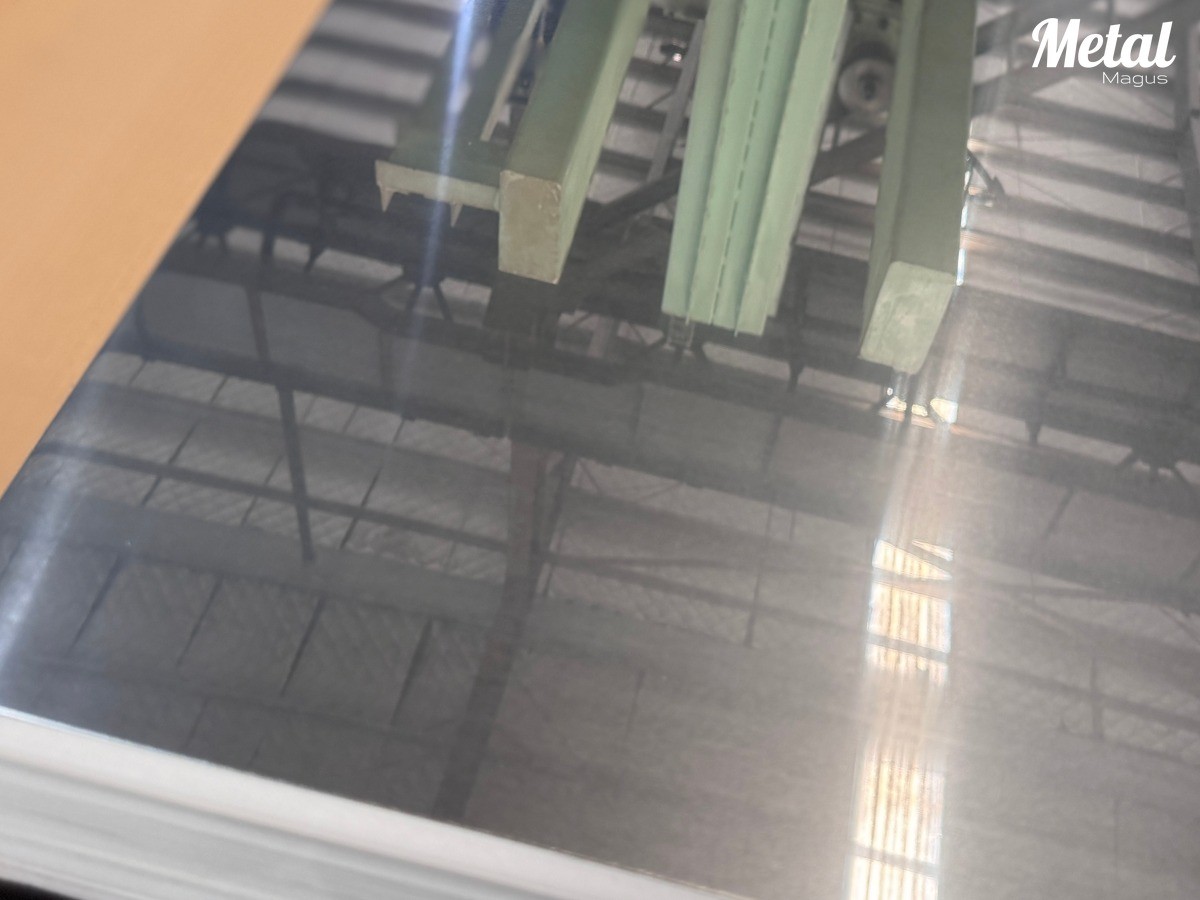
The values below are the production range MetalMagus(杭州新恒裕不锈钢制品有限公司) works to on architectural sheet. They apply to both 304 and 316L unless the process row says otherwise — a distinction that matters, because embossed and perforated surfaces carry their own flatness allowance and should never be quoted against the general figure.
| Parameter | Range / Value | Notes |
|---|---|---|
| Thickness | 0.3–3.0 mm | Tolerance ±0.01 mm |
| Width | 10–1500 mm | Tolerance −0 / +0.2 mm |
| Length | 300–6000 mm | Tolerance −0 / +0.2 mm |
| Flatness, general | ≤3 mm | Mirror, brushed, 2B, BA |
| Flatness, textured | ≤10 mm | Water ripple, hammered, 3D embossed, laser-cut |
| Colour difference, material-native | ΔE < 1.0 | 8K mirror, No.4, twill, blasted, nano anti-fingerprint |
| Colour difference, PVD and antique | ΔE 1.0–1.5 | Batch to batch, measured against retained reference |
| Colour difference, physical forming | Not measured | Pattern, not colour, is the variable |
| Fire rating | A1 | Non-combustible, both grades |
| Substrates | 304 / 316L / 201 and others | Grade stated on the mill certificate |
| Packaging | PVC film + waterproof paper + wooden crate | Laser film available on request |
Note the ΔE split. Material-native finishes hold ΔE below 1.0 because the surface is the metal itself. Every PVD colour and antique finish holds 1.0–1.5 between batches, because a coating cycle introduces variables that polishing does not. Any supplier quoting a single ΔE figure across all finishes is quoting the easy half of the range. A ΔE of 1.2 on a PVD panel and a ΔE of 1.2 on a mirror panel are not the same achievement: the mirror surface has no coating cycle to introduce variation, so its ceiling is lower and its tolerance should be tighter. That asymmetry is why we publish the classes separately, and why the finish-by-finish view of Ra and colour belongs beside the grade decision — see our guide to surface finish selection.
Does the "L" in 316L Matter for Welded Facades?
Yes, and the cases where it matters are predictable. Sheet that is bent and bolted keeps its corrosion resistance regardless of carbon content; sheet that is welded does not.
During welding the metal adjacent to the bead passes through 450–850 °C, the sensitisation range. In that window chromium migrates to form carbides at the grain boundaries, and the metal immediately around them is left chromium-depleted. If carbon started at 0.08%, enough carbide forms to leave a continuous depleted band. If it started at 0.03%, the carbides are sparse enough that the passive film re-forms.
On a facade the practical consequence is a narrow line of rust 2–3 mm from every weld, appearing months after handover. On a canopy soffit or a balustrade with hundreds of metres of weld, that line is the whole story.
There is a second-order point that catches fabricators. Sensitisation is a function of time at temperature as much as of peak temperature, so a slow manual weld on thick section does more damage than a fast machine weld on thin sheet. On 3.0 mm sheet the risk window is wide enough that a 316L specification is doing real work; on 0.8 mm sheet welded at speed it is mostly insurance. Either way, the cost of writing "L" is trivial against the cost of a rust line on a finished elevation.
If your project has welded 316 anywhere in the specification, write 316L, not 316. The cost difference between the two is small; the cost of remediation on a completed facade is not.
When Is 304 the Right Specification?
304 is the correct answer more often than specifiers expect. Interior wall cladding, lift car panels, ceiling systems, reception desks, trim, partition framing and shop-front surrounds are all 304 territory, and specifying 316L for them adds cost without adding service life.
The test is chloride arrival, not distance from the sea. A 30-storey tower 200 metres inland but directly downwind of surf spray behaves like a coastal site. An enclosed atrium in the same building behaves like a dry interior. Altitude, prevailing wind, neighbouring buildings and the presence of a salt-water pool all shift the answer, which is why exposure assessment belongs in the specification, not in the sales conversation.
One more case worth naming: 304 for welded interior elements. A brushed 304 balustrade with continuous welds in a humid lobby will show weld-adjacent staining within a season. Where the element is welded and the environment is humid, 316L is the cheaper decision over the life of the building.
Which Grade for Coastal, Industrial and Desert Projects?
ISO 9223 classifies atmospheric corrosivity from C1 to CX, and the categories map onto grade selection more cleanly than any rule of thumb. The table below is the default we apply before project-specific testing.
| Exposure category | Environment | Default grade | Why |
|---|---|---|---|
| C1–C2 | Heated interiors, dry inland | 304 | No chloride load; PREN 19 is ample |
| C3 | Urban inland, moderate humidity | 304, 316L where welded | Pollution raises local chloride |
| C4 | Coastal beyond 1 km, industrial | 316L | PREN 25 needed for intermittent chloride |
| C5-M | Marine atmosphere, surf zone | 316L minimum | Continuous salt deposition |
| CX | Splash zone, de-icing salt contact | Duplex or higher alloy | 316L is not sufficient |
Two adjustments matter in practice. First, desert sites are not automatically low-corrosivity. Gulf coast projects combine airborne chloride with abrasive dust and high day-night thermal cycling; the dust holds salt against the surface and the cycling works the passive film. Second, de-icing salt changes everything inland. A facade beside a road treated with calcium chloride every winter sits in C4 conditions regardless of distance from the coast.
Where the exposure sits between categories, the honest answer is a site-specific test or an agreed 316L upgrade. Guessing upward costs money; guessing downward costs a facade.
The category approach only works if the climate inputs are right. Salt deposition, dust load and thermal cycling vary at the scale of a single site, and the climate-specific version of this matrix — including how finish choice changes with it — is set out under coastal and desert facade specification.
How Do You Verify the Grade After Delivery?
Three methods, in descending order of reliability: a mill certificate, a positive material identification reading, and a magnet.
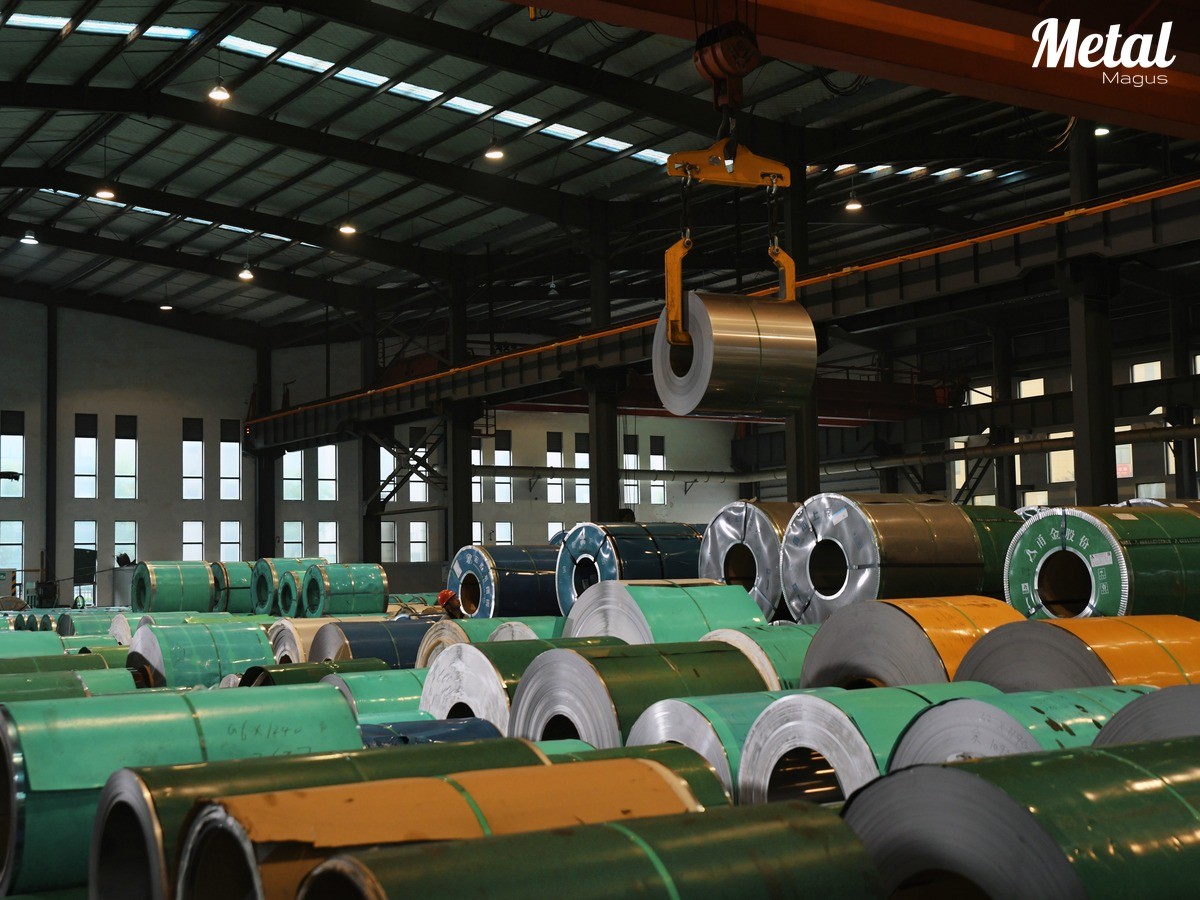
The mill certificate to EN 10204 3.1 is issued by the steelmaker and states heat number, chemistry and mechanical properties. It is the document a consultant asks for, and it should travel with every delivery, not on request after a dispute.
PMI — positive material identification — uses a handheld X-ray fluorescence or LIBS analyser and reads alloy content in seconds. The decisive reading is molybdenum: 304 returns essentially zero, 316L returns 2–3%. A PMI check on incoming sheet catches the most common substitution in the market, which is 304 supplied against a 316L order.
The magnet is the method everyone uses and the one that proves least. Both grades are austenitic and non-magnetic when annealed, so a magnet sticking tells you almost nothing. Worse, cold working transforms some austenite to martensite, so a heavily bent or laser-cut 304 edge will attract a magnet while a perfectly genuine 316L flat panel will not. A magnet can raise a question; it cannot answer one.
What Drives the Cost Difference?
Pricing follows the daily stainless market; ask us for a quotation. What can be explained is the structure behind the number. 316L costs more because it contains more of the expensive elements: 10–14% nickel against roughly 8%, plus 2–3% molybdenum. Both are exchange-traded commodities, so the premium is not a fixed percentage — it widens and narrows with nickel and molybdenum prices, and it moves faster than most project budgets can absorb mid-tender.
That volatility has a practical consequence for procurement. A quotation that fixes a 316L price for six months is carrying risk somewhere, either in a metal-price clause or in the grade itself. Ask which.
There is also a costing error worth flagging. Teams compare 304 and 316L on a per-tonne basis and conclude the upgrade is expensive, then accept a finish change that adds more per square metre than the alloy ever would. The comparison only means something when both numbers are converted to installed square metres of finished panel, including yield loss from the panel module and the reject rate on a difficult surface.
The larger point is that grade is rarely the dominant cost line. On a facade package, fabrication, surface finishing, tooling and freight usually outweigh the alloy delta — which is why upgrading 600 m² of coastal cladding from 304 to 316L is often a smaller decision than choosing between two finishes.
Specification Checklist Before You Order
Grade is one line in a larger system specification: panel module, joint width, substrate build-up and fixing strategy all sit above it. The system-level view is under exterior façade systems, and the eight items below are the ones that must appear on the purchase order before fabrication starts.
- Grade by exposure category — 304, 316L, or higher alloy, stated with the ISO 9223 category.
- Substrate standard — EN 1.4404 or ASTM A240, named explicitly on the purchase order.
- Thickness and tolerance — within 0.3–3.0 mm, tolerance ±0.01 mm.
- Panel size — width within 10–1500 mm, length within 300–6000 mm, tolerance −0 / +0.2 mm.
- Flatness class — ≤3 mm for mirror and brushed, ≤10 mm for embossed and perforated.
- Finish and its ΔE class — material-native below 1.0, PVD 1.0–1.5 batch to batch.
- Certification — EN 10204 3.1 mill certificate plus PMI report if the grade is critical.
- Packaging and sampling — PVC film, waterproof paper and wooden crate; approved physical sample retained for the project duration.
Two of these are confirmed rather than assumed. Salt spray testing is available on request. Packaging can be supplied to customer requirement.
Missing any one of these is how a technically correct grade still arrives as the wrong panel.
FAQ
Which is better, 304 or 316L?
What does the "L" in 316L mean?
When is 304 good enough?
Can 316L stainless steel rust?
Can I tell 304 and 316L apart by appearance or a magnet?
Is 316L required for coastal facades?
MetalMagus, an architectural stainless steel systems manufacturer, supplies 304, 316L and 201 sheet from 0.3–3.0 mm in widths up to 1500 mm, with mill certificates to EN 10204 3.1 and PMI verification available on request. MOQ is 50 sheets per order. Samples are prepared within 2 days and shipped within 3 days; sample making is free and freight is collect. Standard lead time is 20 days from order confirmation, with a 7-day fast track for urgent programmes — both confirmed against order quantity at order review. If you are weighing two grades on a specific elevation, send the drawings and the site location — we will return a grade recommendation against the exposure category rather than a price list.