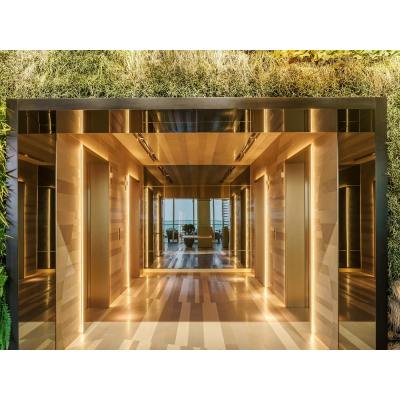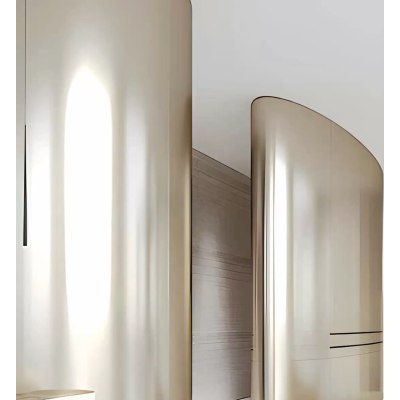
Stainless Steel Facade Panels: Choosing Grade and Finish for Coastal and Desert Climates
For an exterior stainless steel facade, the environment decides the specification — not the render. In salt-laden air the published default is grade 316, and surface roughness should be held at or below Ra 0.5 μm so that salt deposits wash off instead of lodging. In hot, dust-laden climates the priority shifts to finishes that both resist abrasion and hide it: sandblasted, embossed or PVD-coated rather than a purely directional brushed surface.
MetalMagus has made architectural stainless steel in Hangzhou since 2001, across more than 20 production lines in a 58,000 m² plant. The two failure patterns that dominate returned material are chloride attack near coastlines, and heat-driven movement combined with abrasion inland.
Start With the Environment, Not the Finish
Most facade specifications are written in the wrong order. A finish is chosen from a mood board, a grade is added for reassurance, and the climate is treated as a note at the end. On a building that has to look the same in year ten as in year one, the order should be reversed.
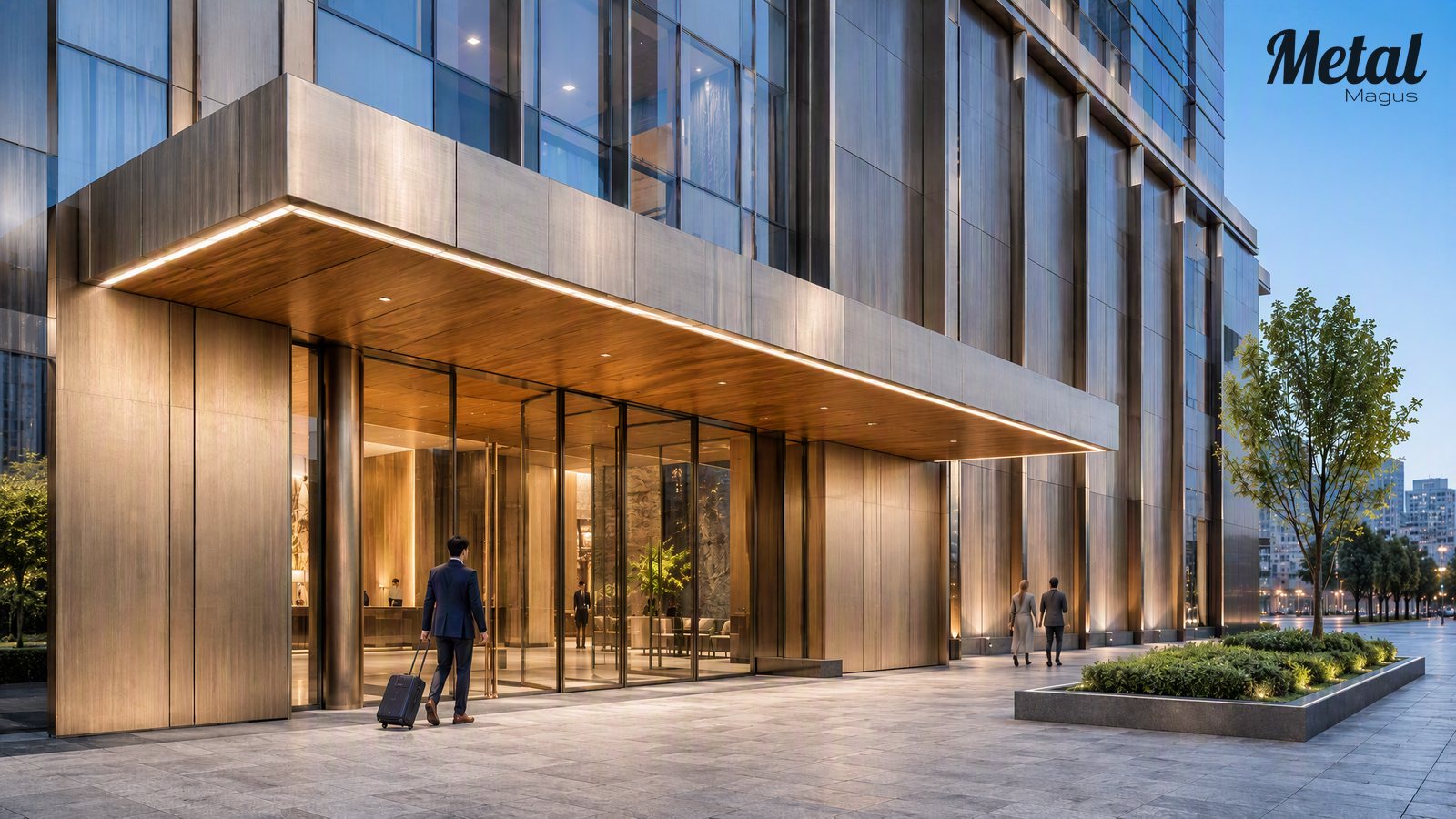
Three environment variables drive almost every exterior decision:
- Chloride exposure — how much salt reaches the panel surface, and how often rain washes it away.
- Thermal cycling — how large the day-to-night and season-to-season temperature swing is, and therefore how much the panels and their fixings move relative to each other.
- Abrasion load — how much wind-borne sand or dust the surface has to absorb over the life of the building.
Get these three right and the finish and grade choices usually resolve themselves. Skip them and the specification becomes a list of preferences that the site will quietly override.
How Salt Air Attacks a Facade
Chloride pitting and crevice corrosion
Stainless steel resists corrosion through a passive chromium-oxide layer. Chlorides attack that layer locally. Where the passive film breaks down and cannot re-form — typically in a pit, under a deposit, or inside a joint that never dries — corrosion progresses in a narrow, deep front rather than spreading evenly. This is why a coastal facade can look perfect in a photograph while a handful of panels are already pitted, and why the damage tends to concentrate at fixings, laps, and the underside of horizontal returns.
Molybdenum is the alloying element that raises resistance to this specific mechanism. That is the practical difference between the two grades most often quoted for facades: 304 contains no deliberate molybdenum addition, while 316L contains it, which is why 316L is the grade specified wherever chlorides are present.
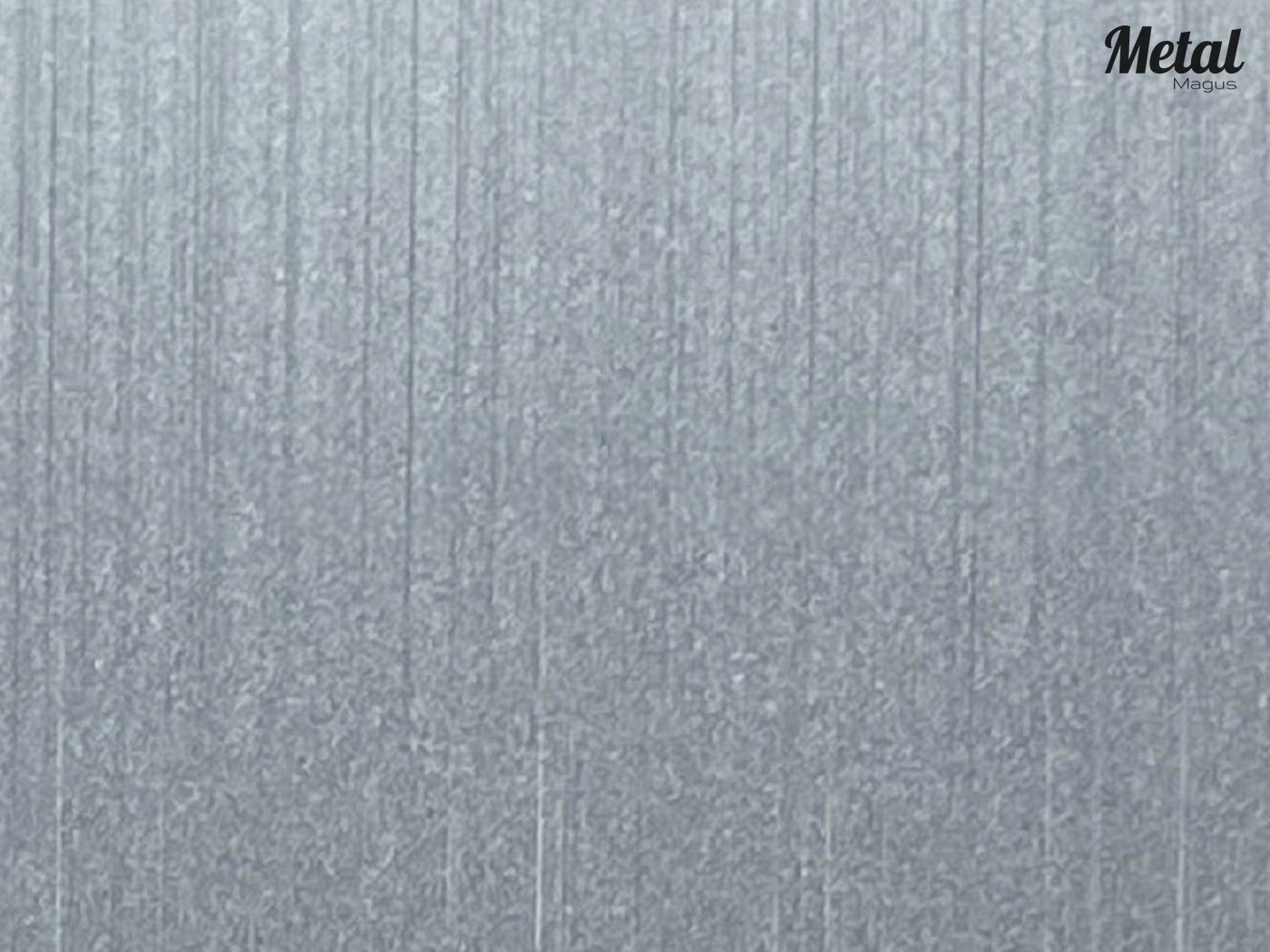
Why surface roughness matters as much as the grade
Grade is only half of the coastal answer. The other half is how long chloride-rich moisture stays in contact with the surface. A rougher surface holds a thinner but more persistent film of moisture, gives salt crystals somewhere to sit, and is harder to clean. The published guidance for marine environments is to hold surface roughness at or below Ra 0.5 μm, on the reasoning that a smoother surface resists salt deposition and is easier to wash.
This has a counter-intuitive consequence: a smooth, non-directional finish in 316L will generally outperform a heavily brushed finish in the same grade on a coastal site — even though the brushed panel looks more "industrial" and therefore more durable.
How Desert Heat and Dust Attack a Facade
Thermal cycling and panel movement
A desert facade experiences large, fast temperature swings. Panels, subframe and fixings expand and contract at different rates because they are different materials and because they are at different temperatures — a dark panel facing the sun runs considerably hotter than the frame behind it. Over years of daily cycling, that differential shows up as:
- fasteners working loose where the fixing detail does not allow movement;
- oil-canning on large, lightly restrained panels as they flex;
- sealant joints opening or being compressed beyond their movement capability.
None of these is a stainless steel problem. They are all detailing problems, and they are the reason a climate-driven specification has to include the subframe and the fixing method, not just the sheet.
UV exposure and colour
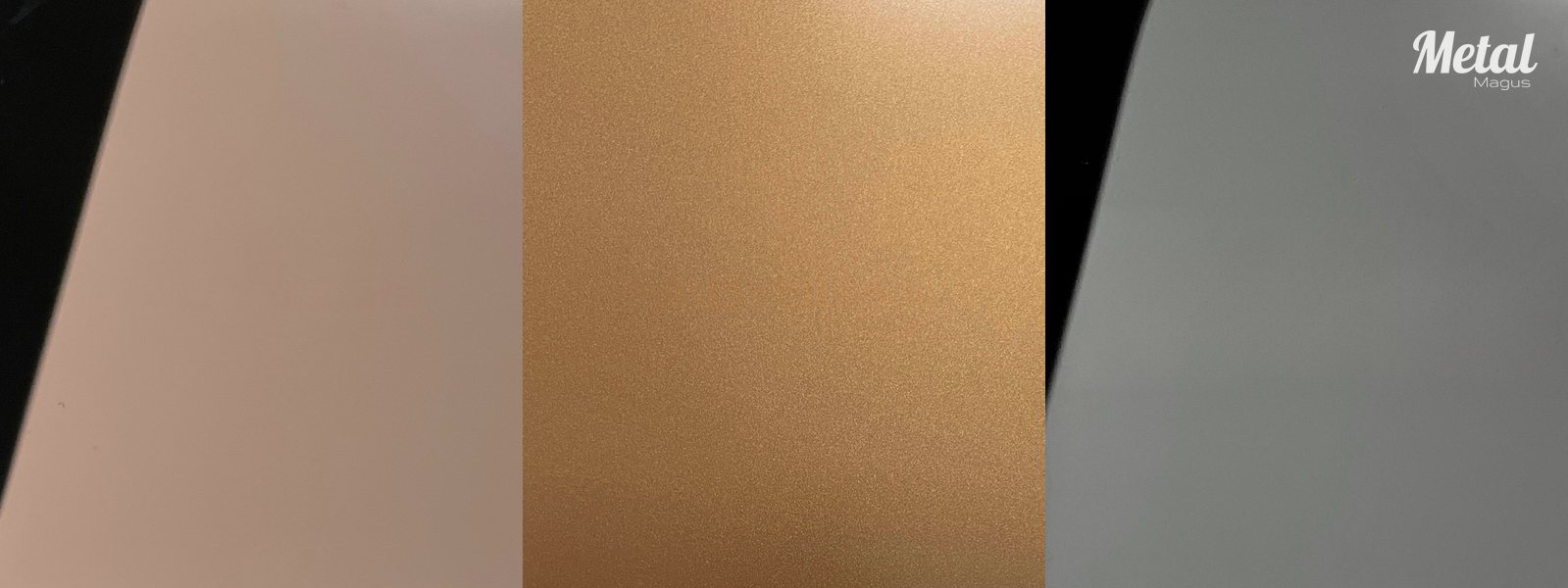
Strong sunlight degrades organic coatings and pigments. PVD colour on stainless steel is a thin mineral layer rather than an organic paint film, so it does not fade through the same pigment-breakdown mechanism. Colour consistency between panels, however, still has to be controlled at the source: MetalMagus measures colour difference per batch against an approved reference with a spectrophotometer and holds it within ΔE < 1.0, which is what keeps a facade from reading as a patchwork when panels from different production batches meet on the same elevation.
Wind-blown sand as an abrasive
Sand and dust are abrasive. On a polished or highly directional surface, every particle that strikes the panel leaves a visible mark, and marks on a mirror surface cannot be repaired in place without changing the sheen of that panel. This is not a corrosion failure — it is cosmetic — but it is the failure most likely to generate a complaint five years after handover, because it accumulates unevenly across an elevation.
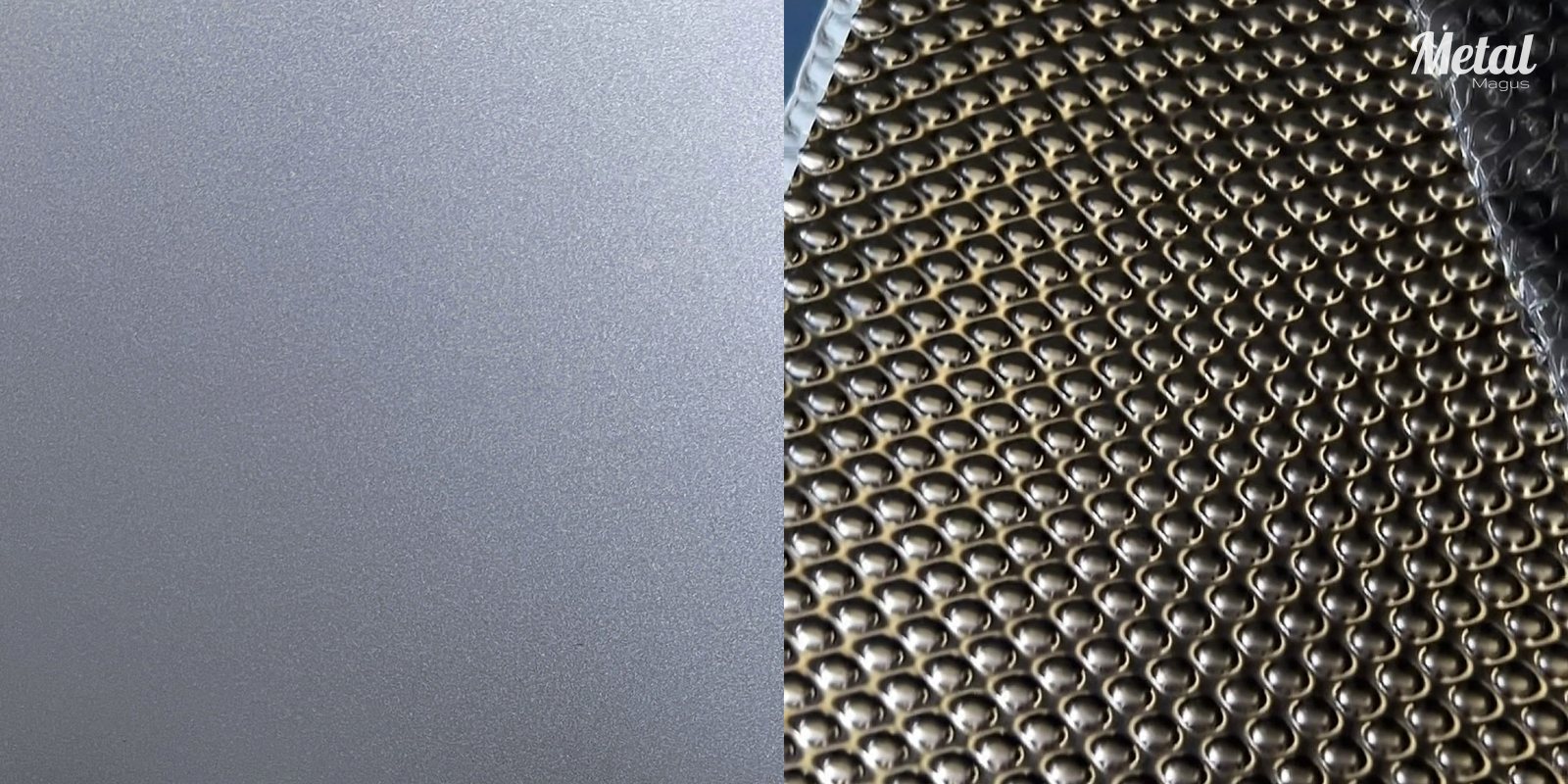
The practical defence is to choose a surface where the abrasion marks match the texture. Sandblasted and embossed finishes scatter light in all directions, so a new scratch adds to the existing pattern instead of interrupting it.
Grade Selection by Climate Zone
| Environment | Grade to specify | Typical PREN | Why |
|---|---|---|---|
| Interior, dry, low pollution | 304 | ~18–19 | Adequate; lowest material cost. Not for exterior exposed faces |
| Inland urban or industrial, moderate pollution | 304, or 316L where de-icing salt is used | ~18–19 / ~24–25 | Atmospheric pollution alone rarely justifies 316L; de-icing salt does |
| Coastal, sheltered, roughly 1–10 km inland | 316L | ~24–25 | Airborne chloride present; molybdenum needed |
| Coastal, exposed, within about 1 km of the sea | 316L minimum | ~24–25 | Direct salt spray and splash; consider higher-alloy grades for the most exposed elevations |
| Hot, dry, inland desert | 304 is workable | ~18–19 | Chloride is low; abrasion and thermal movement drive the finish and detail choices |
| Hot and coastal desert (for example Gulf coastlines) | 316L | ~24–25 | Salt and heat together — the most demanding combination in this table |
PREN values given here are typical for the grade range, calculated from composition using the standard formula PREN = %Cr + 3.3 × %Mo + 16 × %N. Always confirm the actual heat analysis against the mill certificate rather than against the grade name.
Finish Selection by Climate Zone
| Finish | Exterior coastal | Exterior desert | Comments |
|---|---|---|---|
| 2B (mill finish) | Not recommended | Not recommended | A mill surface, not an architectural face; designed for further processing |
| BA (bright annealed) | Not recommended | Limited use | Bright and non-directional, but exterior water spotting is difficult to manage |
| No. 4 / hairline brushed | Not recommended | Limited use | Directional grain channels water and dust; streaking follows the grain |
| Sandblasted, non-directional | Suitable | Preferred | Scatters light evenly, conceals abrasion marks, easier to clean than a grain finish |
| Embossed / textured | Suitable | Preferred | Texture interrupts the water film and disguises impact marks; strong choice for feature areas |
| PVD-coated (on a BA or blasted base) | Suitable with correct detailing | Preferred | Colour is a mineral layer, not an organic coating; batch colour held to ΔE < 1.0 |
| Mirror (8K) | Not recommended | Not recommended | Every defect reads as a defect; exterior damage cannot be repaired in place |
| Etched | Limited, sheltered areas | Limited, sheltered areas | Recessed pattern traps contamination; requires a defined cleaning regime |
Two notes on reading this table. First, "suitable with correct detailing" for PVD on a coastal site means the coating must not be asked to cover cut edges and drilled holes on an exposed face — those areas need to be either protected from standing moisture or detailed so that they drain. Second, sandblasted and embossed finishes are more forgiving in service, but they cost more to produce than a mill or bright finish, so the decision is a real trade-off rather than a free upgrade.
Detailing Rules That Decide Whether the Specification Survives
Material and finish choices can be undermined by details that are decided late, on site, by someone who was not part of the specification. These are the ones that matter most in aggressive climates.
- Run the grain, or the texture, the way water drains. On a directional finish, vertical orientation lets water and dust travel down and off. Horizontal grain on an exposed elevation holds streaks.
- Never let the panel sit in standing water. Slope horizontal returns, put a drip detail under the bottom edge, and make sure the cavity behind the cladding can drain and ventilate rather than trap moisture.
- Isolate dissimilar metals. Where stainless steel meets a different metal, use an isolating washer or a non-absorbent gasket so the two are not in direct electrical contact in the presence of moisture.
- Design the movement path. Decide, and show on the drawing, where the panel can move and where it is restrained. This is the single most common root cause of the movement-related defects listed earlier.
- Keep fixings accessible and replaceable. Choose a fixing method that allows one panel to be changed without dismantling a whole elevation.
- Define cleaning at the specification stage. Salt and dust both need to be removed on a cycle, not "when it looks dirty". If the building's maintenance regime cannot reach a surface, do not specify that surface there.
A Specification Checklist You Can Hand to Your Fabricator
Before a facade package is released, these items should be answered in writing:
- Distance to the sea and the local description of airborne chloride exposure.
- Grade, with the mill certificate's actual Mo content — not just the grade name.
- Target surface roughness in Ra, and the method used to verify it.
- Finish family, and the grain or pattern direction relative to the drainage path.
- Colour control method and tolerance for panels from different production batches.
- Subframe material, fixing method, and the movement allowance designed into the detail.
- A cleaning and inspection cycle that the building's maintenance team can actually execute.
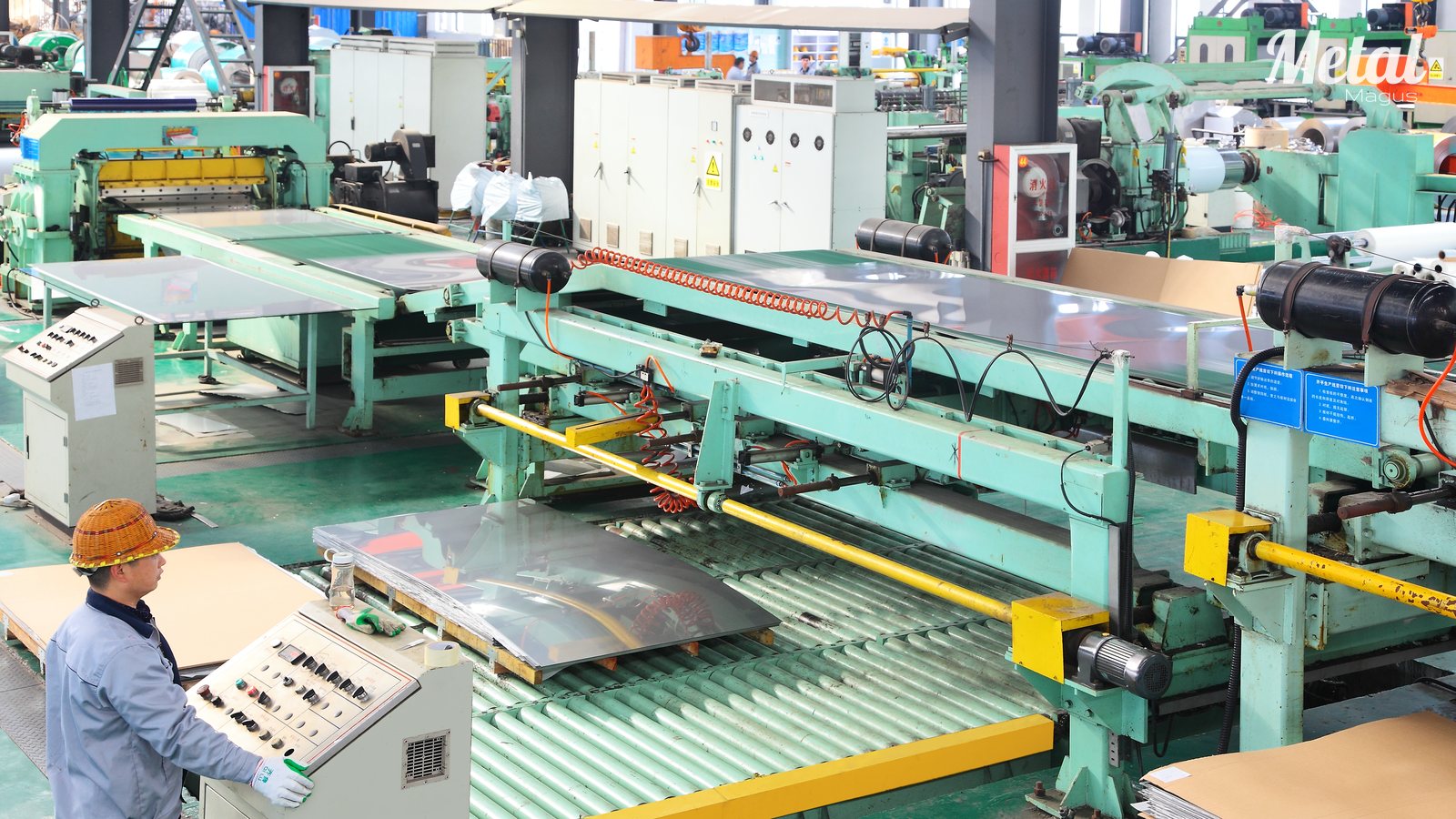
- Panel sizes and thicknesses, agreed against the flatness the design demands. MetalMagus produces cut-to-length panel from a flying-shear line with a maximum sheet width of 1,600 mm, lengths from 4.2 m to 6.0 m, thicknesses from 0.4 mm to 3.0 mm and a flatness of ±2–3 mm — useful when a facade is being detailed to minimise joint lines. You can read the full line specification in our news section.
FAQ
Is 304 good enough for a coastal facade? Only if the elevation is genuinely sheltered and you have confirmed that chlorides are not reaching the surface. For exposed coastal work, 316L is the reasonable baseline because its molybdenum content is what resists localised chloride attack. If you are weighing the two grades on a specific project, the trade-off is set out in our guide to 304 vs 316L.
Which finish hides damage best in a dusty climate? A non-directional one. Sandblasted and embossed surfaces scatter light in every direction, so a fresh abrasion mark blends into the existing texture instead of cutting a bright line across it. A brushed surface is the opposite: the grain makes every new mark conspicuous and gives it a direction to run in.
Does PVD colour fade in strong sunlight? The colour layer is mineral rather than an organic pigment film, so it does not fade through pigment breakdown. The practical risk on a sun-facing facade is not fading but consistency — which is why colour is measured per batch against an approved reference. The method is described in our article on PVD colour consistency for facade panels.
How do we know the panels will match across a phased delivery? Colour is verified per batch against a retained approved reference with a spectrophotometer, held within ΔE < 1.0, and the reference is kept for the duration of the project so that later phases are compared against the same standard rather than against the previous shipment.
Can you supply panels cut to length for a large facade? Yes. Dimensions, thickness and flatness are agreed at the detailing stage and produced on our cut-to-length line; the capability range is on our capabilities page, and the surface finishes themselves are listed under products.
Talk to Our Team
If you are specifying an exterior facade in a coastal or desert climate, the fastest way to resolve the grade-and-finish question is to send us the environment and the elevation. We quote within 24 hours, and samples within 48 hours, so you can compare a sandblasted, embossed and PVD panel against your own daylight before the specification is frozen.
Request a quotation or contact our team. For examples of how these materials come together on buildings, see our material and system studies, and for common specification questions, our FAQ page.
---